Key Takeaways
-
Relific is a productised, AI-first CSR and impact operations platform best suited for corporates that want fast deployment, standardised BRSR-ready reporting, and unified data across CSR, ESG, and programme functions.
-
Dhwani RIS is a decade-old, consultative ICT partner best suited for complex, multi-entity CSR structures that need deeply customised builds and a long-term delivery relationship.
-
In 2026, the decisive factor is that BRSR Core assurance readiness source-traceable, auditable data matters more than dashboards.
-
Evaluate both on time-to-first-report, cost of multi-NGO onboarding, and audit-grade data integrity, not on feature checklists.
-
Neither vendor publishes public pricing; use a 3-year TCO framework in your RFP.
Quick Comparison Summary: Relific vs Dhwani RIS
| Dimension | Relific | Dhwani RIS |
|---|---|---|
| Core positioning | AI-native impact operations stack (Surve-R, ProGran, Voluntee-R) | Custom ICT solutions for the social sector (mGrant, mForm, DaaS) |
| Primary approach | Productised SaaS modules | Tailor-made, consultative builds |
| Strongest for | Corporations seeking speed-to-deploy, automated BRSR-ready reporting | Large foundations and multi-entity CSR programs needing heavily customised workflows |
| Deployment speed | Faster, modular, configurable | Slower-scoped, custom implementation |
| Data collection | AI-assisted surveys and field forms (Surve-R) | Field-tested no-code forms (mForm) |
| Grants & programmes | ProGran (end-to-end programme and grants operations) | mGrant (widely used by large enterprises) |
| Volunteering & employee engagement | Voluntee-R dedicated employee volunteering module | Typically delivered through custom builds |
| Track record | Newer, AI-first entrant | Established in 2012, clients include Mahindra, HDFC Bank, and Reliance Foundation |
If you are shortlisting CSR software in India for 2026, the decision is no longer about which platform has more features. It is about which platform reduces reporting risk, accelerates BRSR-aligned disclosures, and scales with multi-NGO execution without choking your team in manual reconciliation.
This comparison of Relific vs Dhwani RIS is written for that decision. Both are credible, India-focused platforms. They solve adjacent problems differently, and the right choice depends on how your CSR function is structured, not on marketing claims.
Why This Comparison Matters in 2026
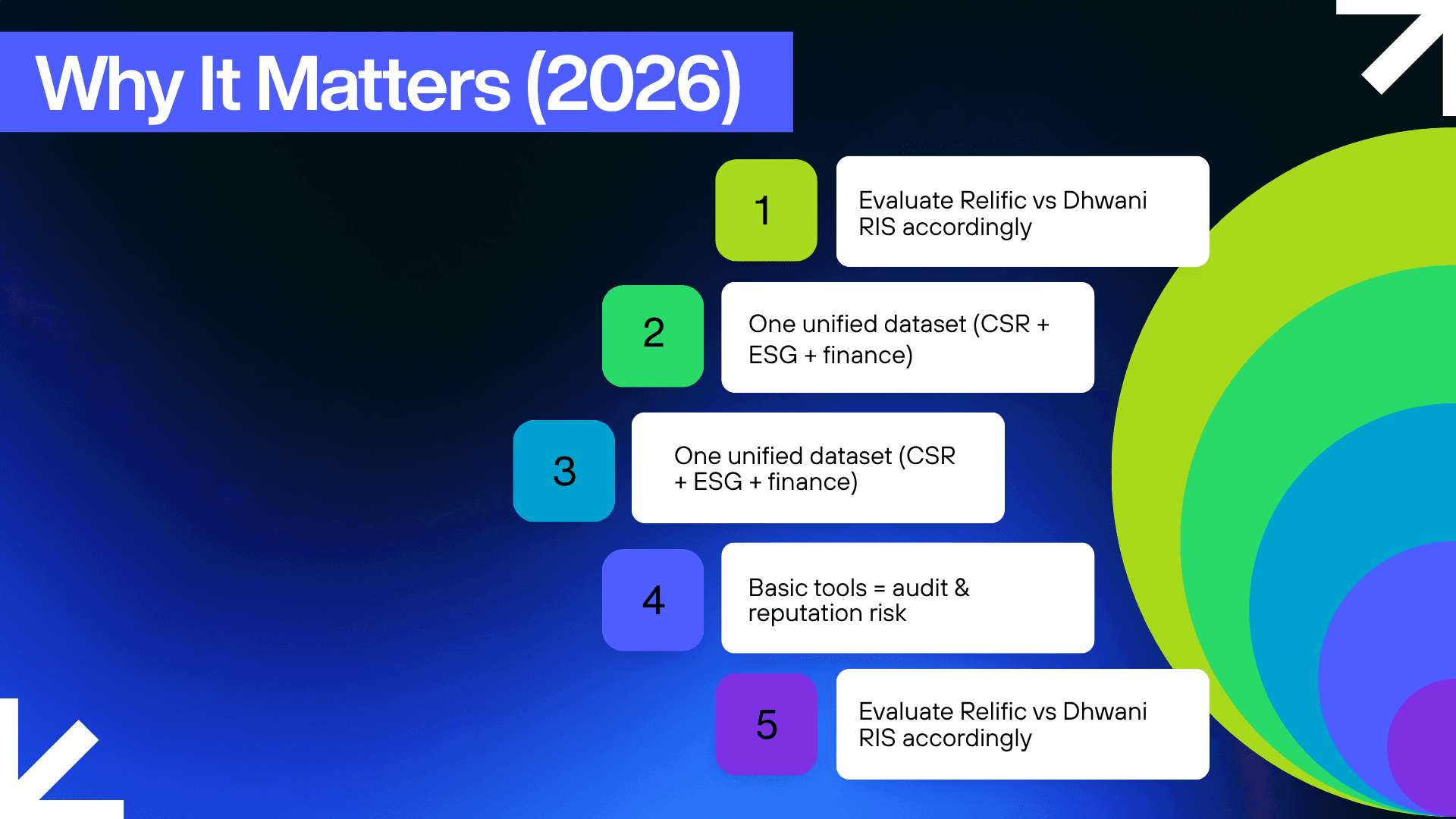
The regulatory pressure on Indian corporates has tightened meaningfully. SEBI's BRSR framework already mandates disclosures from the top 1,000 listed companies, and from FY 2026–27, reasonable assurance on BRSR Core KPIs extends to all top 1,000, up from the top 500 in FY 2025–26. That shift alone changes the buying criteria for CSR and ESG software.
Three consequences follow:
- Disclosures now need source-level traceability, not narrative summaries.
- NGO and vendor data must be auditable, not just aggregated.
- CSR, ESG, and finance functions need to share one version of the truth.
Choosing a tool that treats CSR as a spreadsheet exercise will cost you later in audit queries, exchange notices, and reputational risk. That is the backdrop against which Relific and Dhwani RIS should be evaluated.
What is CSR Software?
CSR software is a system of record and system of action for a company's Corporate Social Responsibility programmes. A capable platform typically covers four functions:
-
Compliance tracking: Section 135 obligations, CSR-1/CSR-2 filings, BRSR disclosures.
-
Programme and grant management: planning budgets, disbursing to implementation partners, tracking milestones.
-
Field data collection and monitoring: beneficiary data, outcomes, evidence capture.
-
Reporting and impact analytics: dashboards, audit trails, ESG-aligned outputs.
The best CSR reporting tools in India do not just digitise paperwork. They reduce the gap between what happens on the ground and what gets reported to the board, the auditor, and the regulator.
Overview: Relific and Dhwani RIS
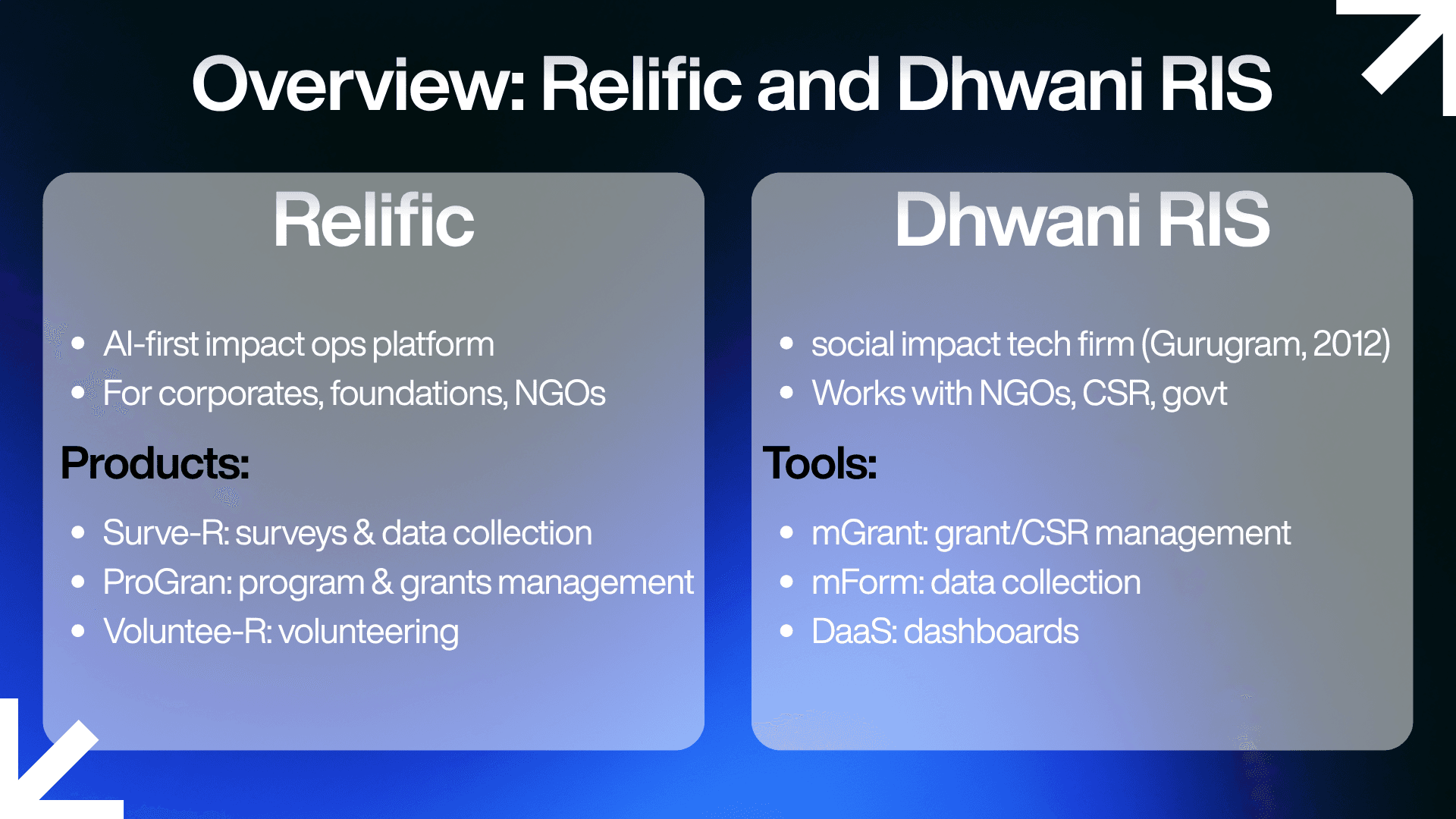
Relific
Relific is an AI-first impact operations platform built for corporates, foundations, and NGOs. Its stack is organised into three modules:
- Surve-R: AI-assisted surveys and field data collection.
- ProGran: programme and grants operations, end-to-end.
- Voluntee-R: employee volunteering and engagement management.
The product philosophy is "productised impact ops" field collection, programme execution, and volunteer engagement on a single stack, with AI embedded in form design, data validation, and reporting workflows. Relific positions itself for organisations that want to move quickly, standardise CSR data, and produce compliance-grade reporting without building custom systems from scratch.
Dhwani RIS
Dhwani Rural Information Systems is a Gurugram-based technology firm founded in 2012 by Sunandan Madan and Swapnil Agarwal. It operates as a social-impact-focused ICT partner, with a team of 100+ professionals serving nonprofits, CSR functions, foundations, impact investors, and government programmes.
Its core offerings include:
- mGrant: grant management for donor relations, project tracking, and reporting.
- mForm: no-code form platform for field data and beneficiary tracking.
- Dashboard as a Service (DaaS): configurable data visualisation layer.
Dhwani's model is consultative and high-touch. Based on publicly available information, its reference list includes Mahindra Group (where mGrant tracks 100+ CSR activities across 30 companies), HDFC Bank, Reliance Foundation, Vedanta, Sattva, and several government and international partners.
Feature-by-Feature Comparison
| Feature Area | Relific | Dhwani RIS |
|---|---|---|
| Compliance tracking (Section 135, BRSR, ESG) | Built-in compliance and reporting workflows designed around Indian CSR and BRSR requirements | Compliance handled via configured mGrant and custom builds; depth depends on project scope |
| Reporting automation | AI-assisted reporting workflows across Surve-R and ProGran; standardised, BRSR-aligned templates | Configurable dashboards via DaaS; strong customisation, typically scoped per client |
| Data accuracy & audit readiness | Unified data flow across surveys, programmes, and volunteering with source traceability and AI validation | Field-tested data pipelines from mForm; audit trails depend on implementation |
| NGO / vendor management | ProGran handles onboarding, disbursement, milestones, and documentation | mGrant is mature and widely used by large Indian conglomerates for multi-NGO tracking |
| Field data collection | Surve-R AI-assisted surveys and forms, offline-capable | mForm no-code, multilingual, widely deployed in rural settings |
| Employee volunteering | Voluntee-R productised module for employee volunteering hours, drives, and engagement reporting | Delivered via custom builds when scoped in the engagement |
| Integration capabilities | Modern integrations across ERP, HR, finance, and reporting systems | Custom integrations delivered project by project |
| UX and scalability | Productised SaaS faster to deploy, consistent UX across clients | Tailored UX per client; scalability tied to implementation scope |
| Deployment model | Configurable SaaS modules | Custom-delivered solutions with ongoing support |
Based on available public information, the exact feature depth should be validated in a demo against your specific CSR and BRSR scope.
Which Platform is Better for BRSR Compliance in 2026?
Direct answer: For listed companies navigating SEBI's expanded BRSR Core assurance scope in FY 2026–27, Relific tends to be the faster, more standardised path because its reporting, data integration, and audit-trail features are productised around Indian CSR and ESG disclosures. Dhwani RIS can absolutely deliver BRSR-aligned systems, but because its model is consultative, depth and timeline depend on how the engagement is scoped.
Put differently:
-
If you want a ready platform that accelerates BRSR-ready reporting with less implementation overhead → Relific is the more direct fit.
-
If you want a custom-built reporting environment tied to a complex, multi-entity CSR structure, and you have the timeline and budget for a bespoke build → Dhwani RIS is a strong candidate.
Use Case Scenarios: Who Should Choose What?
Choose Relific if you are:
- A listed company entering the expanded BRSR Core assurance net in FY 2026–27.
- A corporate foundation running multi-state CSR programmes that need standardised reporting across 10–50 NGOs.
- An ESG or sustainability team that needs to unify CSR, BRSR, and impact data on one stack.
- A company running a structured employee volunteering programme and needing to track hours, drives, and engagement alongside CSR disclosures.
- An organisation with limited internal engineering bandwidth that wants a configured product rather than a custom build.
Choose Dhwani RIS if you are:
- A large conglomerate with a complex, multi-company CSR structure and a preference for a tailor-made MIS.
- A foundation running non-standard programmes (rural livelihoods, health, education) needing heavily customised workflows.
- An organisation that values a long-term consultative partnership and has the budget and patience for bespoke builds.
- A government or multilaterally funded programme where field realities demand deep customisation and regional language support.
Pros and Cons: An Honest Read
Relific pros/cons pros
- AI-native architecture reduces manual data cleaning and reconciliation.
- Productised modules (Surve-R, ProGran, Voluntee-R) mean predictable deployment timelines.
- Designed with Indian CSR, BRSR, and ESG contexts in mind.
- Dedicated employee volunteering module a capability that usually requires custom builds on alternative platforms.
- Easier to onboard NGO partners at scale without rebuilding workflows each time.
Cons
- As a newer entrant, its reference base is still growing compared to decade-old players.
- Deep customisation beyond the productised modules may require scoped work.
Dhwani RIS pros/cons pros
- Over a decade of delivery experience in the Indian social sector.
- Strong reference clients include the Mahindra Group, HDFC Bank, Reliance Foundation, and Vedanta.
- Proven field deployments through mForm, including rural and multilingual contexts.
- High-touch, consultative approach useful for unusual or complex programme designs.
Cons
- Custom builds typically mean longer timelines and higher total cost of ownership.
- BRSR-specific and ESG-assurance depth are tied to each engagement's scope.
- Standardisation across multiple implementations may be uneven because the model is project-based.
Pricing and Scalability Considerations
Neither Relific nor Dhwani RIS publishes standardised pricing on their public websites, which is common for enterprise CSR and ESG software in India. Rather than guess, use this evaluation framework in your RFP or demo:
- Total cost of ownership (3 years): licence + implementation + customisation + support.
- Time-to-first-report: how quickly you can produce an audit-ready BRSR or CSR report.
- Per-NGO onboarding effort: how much implementation work is needed for each new partner?
- Scalability model: Does cost scale with users, programmes, or data volume?
- Assurance-readiness: Can the vendor demonstrate how their outputs stand up to statutory auditor scrutiny?
Based on their public positioning, Relific typically fits a SaaS-style cost structure that scales with usage, while Dhwani RIS engagements tend to follow a project-plus-support commercial model. Validate both against your internal procurement norms.
Decision Checklist for Buyers
Before you commit, score each vendor on these twelve questions:
- Does the platform produce BRSR Core-ready outputs with source traceability?
- Can it generate CSR-2 and Section 135 disclosures without manual re-work?
- How is data from 50+ NGO partners ingested, validated, and reconciled?
- Is there an audit trail for every edit, approval, and disbursement?
- Does it integrate with your ERP, finance, and HR systems out of the box?
- What is the realistic go-live timeline in weeks or quarters?
- How is regional-language field data handled?
- Who owns the data model, and can you export it cleanly on exit?
- What is the assurance experience that the vendor has supported Big Four audits?
- How are security, data residency, and access controls handled?
- What is the 3-year total cost, including customisation and support?
- Does the vendor have reference clients in your sector and company size?
Conclusion: Choose Based on How You Operate, Not What You Read
The honest answer in any Relific vs Dhwani RIS comparison is that both are legitimate choices for different buyers. Dhwani RIS has depth and a strong reference list built over more than a decade. Relific brings a productised, AI-first approach that aligns well with how BRSR assurance expectations are tightening in 2026.
The question is not "which is better?" It is "which fits how my CSR function actually runs?"
-
If your CSR team is small, your NGO base is wide, and your BRSR deadlines are non-negotiable, a productised platform like Relific will typically get you there faster.
-
If your CSR structure is multi-entity, your programmes are non-standard, and you have the runway for a custom build, Dhwani RIS remains a strong partner.
Either way, the right next step is the same: put both vendors through a demo scoped to your exact BRSR Core KPIs, NGO count, and integration stack. Let the shortlist be decided by how each handles your data, not by how well each pitches.
Frequently Asked Questions
1. Which is the best CSR software in India for BRSR compliance in 2026?
The better fit depends on your structure. For standardised, faster-to-deploy BRSR-ready reporting, Relific is typically the more direct choice. For deeply customised, multi-entity CSR reporting systems, Dhwani RIS is a credible alternative. Both can support BRSR when scoped correctly.
2. Is Relific a good alternative to Dhwani RIS?
Yes, for organisations that prefer a productised SaaS approach over custom builds. Relific's AI-assisted data integration, reporting, and grants modules reduce implementation time, whereas Dhwani RIS suits teams that want a consultative, build-to-fit engagement with a longer delivery horizon.
3. What is the difference between CSR software and BRSR compliance software?
CSR software manages Section 135 planning, NGO disbursements, and impact reporting. BRSR compliance software focuses on SEBI's ESG disclosure framework for listed companies. Modern platforms in India increasingly combine both, because data sources overlap across CSR, ESG, and sustainability reporting.
4. Does Dhwani RIS offer a standard off-the-shelf CSR product?
Dhwani RIS offers productised tools, such as Grant for grant management, mForm for data collection, and DaaS for dashboards, but its delivery model is typically consultative and customised per client. The degree of standardisation depends on the engagement scope.
5. Which CSR reporting tools in India support multi-NGO data consolidation?
Both Relific and Dhwani RIS support multi-NGO data consolidation. Relific does it through its ProGran programme and grants module with AI-assisted validation from Surve-R field data. Dhwani RIS delivers it via mGrant and custom integrations, widely used by large Indian conglomerates such as the Mahindra Group.
6. How do I evaluate CSR software pricing in India?
Because pricing is rarely public, request a 3-year total cost of ownership, including licences, implementation, customisation, and support. Benchmark against time-to-first-report, per-NGO onboarding cost, and scalability as users and programmes grow. Avoid vendors that cannot model scaling transparently.
7. Can one platform handle CSR, BRSR, and ESG reporting together?
Yes, and increasingly this is the expectation. Unified platforms reduce reconciliation gaps between CSR and ESG teams, especially under BRSR Core assurance. Relific is explicitly designed around this unified model; Dhwani RIS can deliver it through custom integrations and configured dashboards.