Key Takeaways
-
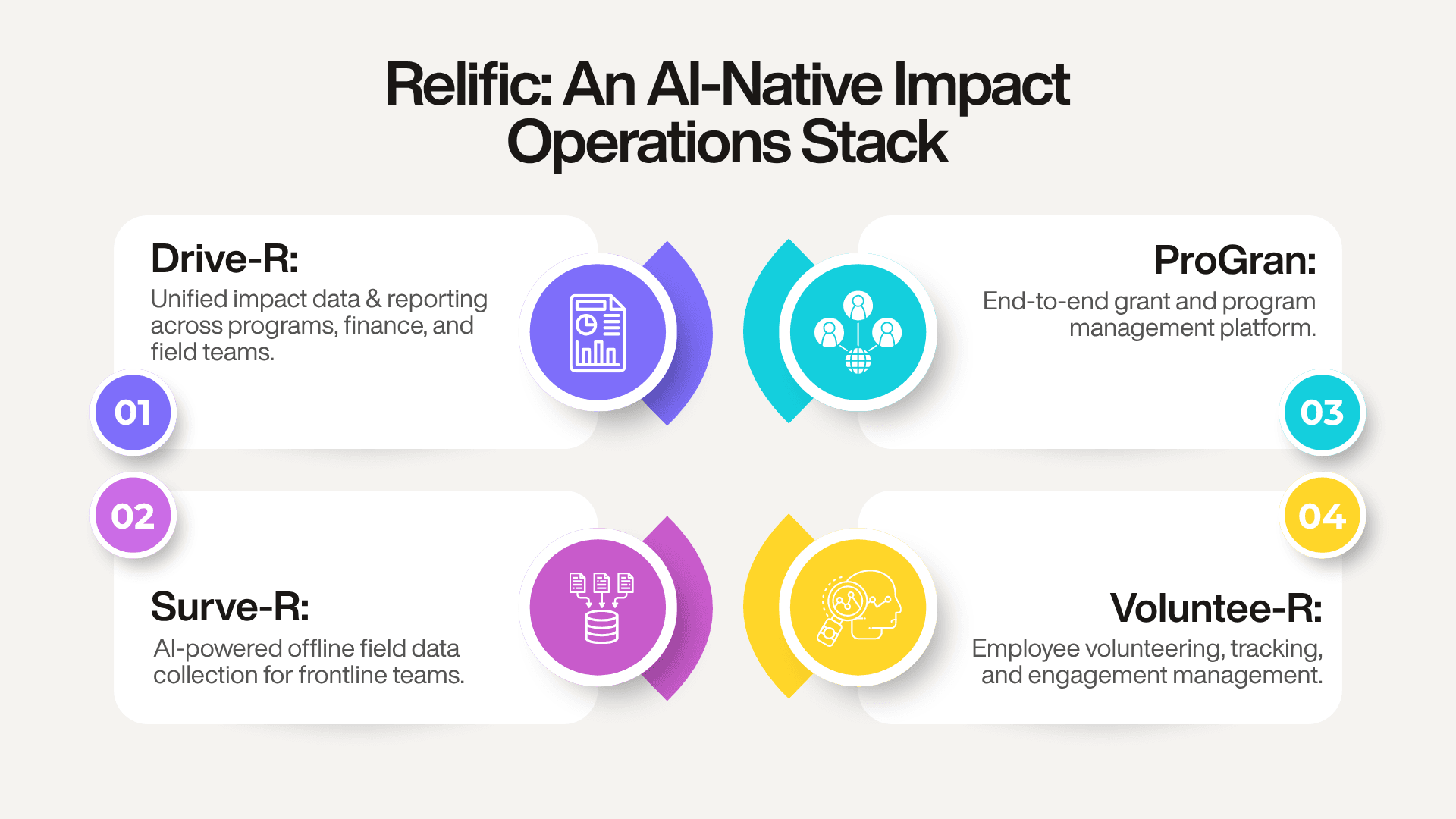
Impact Dash ImpactOne is a compliance- and reporting-focused CSR platform with strong India-specific capabilities, including NGO due diligence (12A, 80G, CSR Form-1, and Audit Reports), Schedule VII and SDG-aligned dashboards, automated CSR reporting (Form-2 and Directors Report) as per MCA guidelines, geo-tagged field asset mapping, and performance dashboards that allow funders and NGOs to track coverage, spending, and program outcomes.
-
Relific is an AI-first impact operations stack for corporates, NGOs, and social enterprises, designed to solve CSR’s upstream data problem through three integrated modules: Surve-R for AI-enabled field data collection, ProGran for program and grants management with KPI and M&E tracking, and Voluntee-R for employee volunteering and impact tracking. Together, they replace fragmented spreadsheets with a continuous, AI-validated workflow that connects field data to operations, volunteering, SEBI-BRSR compliance, SDG reporting, and stakeholder-ready impact disclosures across sectors like education, healthcare, livelihoods, agriculture, and climate action.
-
In 2026, the decisive criterion is BRSR Core assurance readiness: source-traceable, audit-grade data matters more than polished dashboards alone.
-
Evaluate vendors on time-to-first-report, multi-NGO onboarding cost, and audit traceability, not on feature checklists.
-
Neither platform publishes public pricing. Use a 3-year TCO framework when comparing proposals.
Why This Choice Actually Matters in 2026
The era when CSR could be run on spreadsheets, PDFs, and disconnected email threads is over. Two structural shifts have made the platform decision strategic rather than administrative.
The first is regulation. SEBI's BRSR Core framework now requires reasonable assurance, meaning third-party verified, audit-grade data on a defined set of ESG KPIs, with phased applicability extending from the top 150 listed entities (FY 2023–24) to the top 1,000 by FY 2026–27. From FY 2024–25, value chain ESG disclosures were added on a comply-or-explain basis for the top 250 companies. In practice, this elevates CSR and ESG data from self-declared narrative to verified disclosure, comparable in rigor to financial reporting.
The second is market scale. Grand View Research estimates the global CSR software market at USD 973.7 million in 2024, projected to reach USD 1.72 billion by 2030 at a 10.1% CAGR. Asia-Pacific is the fastest-growing region. The growth isn't being driven by more companies starting CSR; it's being driven by companies professionalizing how they run it.
Talent and consumer pressure round out the picture. Deloitte's 2024 Gen Z and Millennial Survey, covering nearly 23,000 respondents across 44 countries, found that 75% say a company's community engagement and societal impact matter when considering a potential employer, and 44% of Gen Z respondents said they have already rejected an employer over values misalignment.
Translation for the CSR function: your platform now has to satisfy auditors, board members, regulators, employees, and partner NGOs, often with the same dataset. That is the brief Impact Dash, and Relific is trying to fill, with meaningfully different architectures.
At-a-Glance Comparison|
| Dimension | Relific | Impact Dash |
|---|---|---|
| Core positioning | Drive-R · Surve-R · ProGran: a purpose-built, unified AI stack that unifies fragmented data, collects it on the ground, and reports impact with confidence. One stack for real-world outcomes. | End-to-end impact measurement and compliance management platform with deep Indian regulatory expertise and advisory-layer services. |
| Primary strength | Practical AI embedded at every layer, from ground-level data collection to stakeholder-ready reporting; ensuring clean-at-source, decision-ready impact intelligence without manual assembly. | Established compliance infrastructure, SDG and Schedule VII dashboards, and human advisory depth across 100+ organisations. |
| Reporting | Operationally-fed BRSR-aligned reporting via Drive-R: fragmented data is cleansed, unified, and transformed into stakeholder-specific insights — no post-hoc data chase, no manual assembly. | Visual dashboards with SDG and Schedule VII filtering; board-ready outputs powered by advisory expertise and BI tool integration. |
| NGO due diligence | Structured partner onboarding and full lifecycle management via ProGran: connecting Theory of Change to verified field delivery, built for multi-NGO operations at scale. | Native document collection: 12A, 80G, CSR-1, and audit reports received from NGOs via the impactOne due diligence workflow. |
| Field data collection | Surve-R: mobile-first, AI-assisted field collection purpose-built for ground-level reality; offline forms, GPS tagging, photos, e-signatures, and instant approval workflows out of the box. | Available, but not the architectural centrepiece. |
| Grant management | ProGran delivers end-to-end grant lifecycle management, programme design, KPI tracking, predictive insights, and impact reporting, grounded in live, operationally-verified data. | IdeaOne enables grant-seekers to build proposals and connect with funding agencies in a standardised format. |
| Volunteering | Voluntee-R: a dedicated volunteering module, integrated within the same operational stack, ESG-aligned, and built to feed directly into BRSR and impact reporting workflows. | Volunteer activities can be tracked and reported as part of the broader CSR programme record. |
| AI integration | AI woven into the operational fabric — not an advisory chatbot, but embedded intelligence across data collection (Surve-R), integration (Drive-R), and programme monitoring (ProGran). | ImpactGPT: a specialised advisory AI trained on CSR and social impact domains for contextual query responses and guidance. |
| Track record | Fast-growing corporate and NGO base enabling impact across agriculture, healthcare, education, and climate action, built for the sectors where field reality drives outcomes. | 100+ organisations, 120+ programmes, multi-sector experience across banking, PSU, manufacturing, FMCG, and government agencies. |
| Best fit | Organisations prioritising operational AI, field-verified impact intelligence, and unified end-to-end programme execution. | Organisations prioritising India-specific regulatory compliance, advisory support, and established CSR programme templates. |
Disclosure Before We Compare
I'm a co-founder at Relific, so this comparison isn't a neutral observer's view, and pretending otherwise would be dishonest. What I've tried to do instead is write the comparison I wish existed when I was on the buyer's side: clear about where each platform genuinely wins, candid about the trade-offs, and structured around the questions a CSR head actually has to answer in front of a board. Where Impact Dash is the better fit, I've said so. Where Relific has gaps, I've named them.
Relific: An AI-Native Impact Operations Stack
What It Is
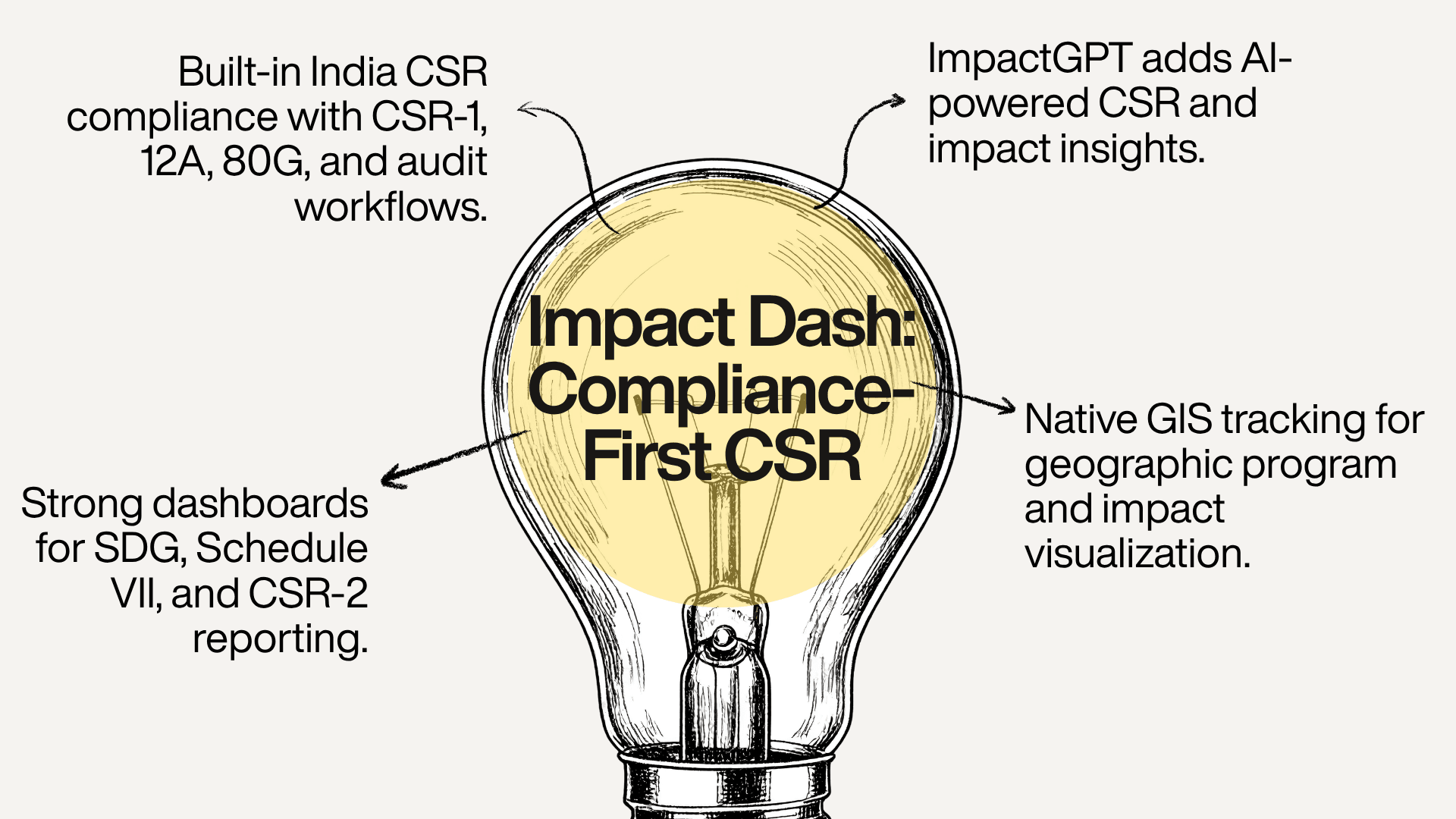
Relific: The Operating System for Social Impact
AI-first impact operations stack built for corporates, NGOs, CSR implementing agencies, and social enterprises, not a reporting tool retrofitted around dashboards.
Drive-R: AI-powered data integration and analytics layer that unifies fragmented impact data across programme, finance, and field sources into a single, audit-ready ESG intelligence pipeline.
Surve-R: AI-assisted mobile field data collection platform with adaptive, offline-ready forms purpose-built for frontline workers and low-connectivity environments, fixing dirty data at the source.
ProGran: End-to-end grants and programme management platform covering the full lifecycle, programme design, grant applications, disbursement tracking, milestone approvals, M&E, and outcome reporting.
Voluntee-R: Dedicated employee volunteering and CSR engagement module for managing corporate volunteer drives, hours tracking, and ESG-aligned employee engagement reporting.
Core thesis: Most CSR programmes don't fail at the dashboard, they fail upstream, with inconsistent field data, manual reconciliation across NGO partners, and reports assembled retrospectively from PDFs and Excel files.
The fix is upstream: By integrating collection, operations, and reporting into one stack, Relific turns BRSR compliance, SDG-linked impact reporting, Schedule VII CSR disclosures, and social impact measurement into a continuous, AI-validated output of live operations, not a year-end reconstruction exercise.
Where It's Strongest
1. Clean-at-source data and BRSR readiness. Because Surve-R structures data at collection and Drive-R unifies it without manual stitching, the reporting layer inherits a defensible audit trail. For companies in the BRSR Core assurance cohort, this matters: an assurance provider doesn't accept a polished number; they want to trace it back to the field record. Architecturally, Relific is built to produce that trace.
2. Multi-NGO operations. ProGran handles the full partner lifecycle inside one workflow: onboarding, milestone tracking, disbursement, documentation, and outcome reporting. For CSR teams working with 10–20+ implementing partners, this collapses what is often three separate tools and a folder hierarchy.
3. Field operations. AI-guided adaptive forms reduce data-entry errors, work offline, and produce analysis-ready data without a downstream cleaning step. For programs in agriculture, public health, education, or climate adaptation, where field data complexity is the limiting constraint on impact measurement, this is a meaningful advantage.
4. Operational AI. Relific's AI is embedded in the workflow anomaly flags on field data, programme design suggestions based on historical outcomes, document parsing during partner onboarding rather than being a separate "ask the chatbot" surface.
5. Employee volunteering as a first-class module. Voluntee-R is built for this rather than being a reporting-side afterthought.
Where It Has Room to Grow
Relific is a younger entrant. The customer base is growing, but is smaller than more established Indian CSR platforms, which matters for procurement teams that weigh reference checks heavily. Companies running mature, multi-crore programs with deeply embedded existing tools will face a real switching cost, and onboarding NGO partners onto a new platform is non-trivial work that cost should be modeled into any TCO comparison, not waved away. Relific's strength in field-heavy operations also means it's less differentiated for companies whose CSR is primarily check-writing and standardized reporting, where simpler tools may suffice. Finally, while the BRSR-aligned templates are well-built, BRSR is a moving target: any platform's "BRSR readiness" should be re-validated against the latest SEBI circulars at the time of purchase, not taken on the strength of a sales deck.
Impact Dash: A Compliance-First Indian CSR Platform
What It Is
Impact Dash is an India-based impact measurement and management company founded by a team with backgrounds from IIT and TISS. Its flagship SaaS product, ImpactOne, is built for the Indian CSR ecosystem as it actually works with fragmented partner networks, Schedule VII obligations, and field-level data collection challenges. The company also operates IdeaOne (proposal and grant pipeline tooling for fund-seekers) and InfinityOne (large-scale government scheme monitoring, e.g., Swachh Bharat Mission–type programs).
According to its public material, Impact Dash has worked with 100+ organisations across banking, PSUs, manufacturing, FMCG, multilateral organisations, non-profits, and IT, managing 120+ programs.
Where It's Strongest
1. India-specific compliance is built in, not bolted on. Companies subject to Section 135 of the Companies Act have to document Schedule VII alignment, file annual CSR-2 reports, and maintain an audit trail. Impact Dash bakes this into the workflow. The NGO due diligence module, where funders can receive Form CSR-1, 12A, and 80G certificates, and audit reports directly inside the platform, is one of the more useful native features for Indian CSR teams. Most competitors handle this over email and shared drives.
2. Dashboards and disclosure formatting are mature. SDG-tagged views, Schedule VII filters, financial-year segmentation, and clean visual outputs make it well-suited to board reporting and CSR-2 disclosures. If the audience for your data is internal audit, the legal team, and the CSR committee, Impact Dash gives you the layer they're used to consuming.
3. GIS-based program tracking. This deserves more attention than it usually gets. Most Indian CSR programs operate across geographically dispersed communities. Spatial visualization coverage by district, demographic overlays, location-of-spend versus location-of-need is increasingly being asked for by independent assessors and trustee committees, and Impact Dash supports it natively.
4. ImpactGPT. Impact Dash has launched a domain-specific AI tool trained on CSR and impact-investing contexts. It's positioned as an advisory layer rather than an operational one, which is a coherent fit with the rest of the product.
Where It Has Room to Grow
The same India-centricity that gives Impact Dash depth also constrains it. Multinationals reporting under GRI Standards, SASB, ISSB, or the EU's CSRD will find that the compliance scaffolding doesn't map one-to-one. The platform is also tilted more toward program management and disclosure than toward employee engagement, workplace giving, and volunteering capabilities that have become central to how large Indian companies operationalize CSR through their workforce. Field data collection exists but isn't the architectural centerpiece, which matters more for some programs than others.
Head-to-Head on the Dimensions That Actually Matter
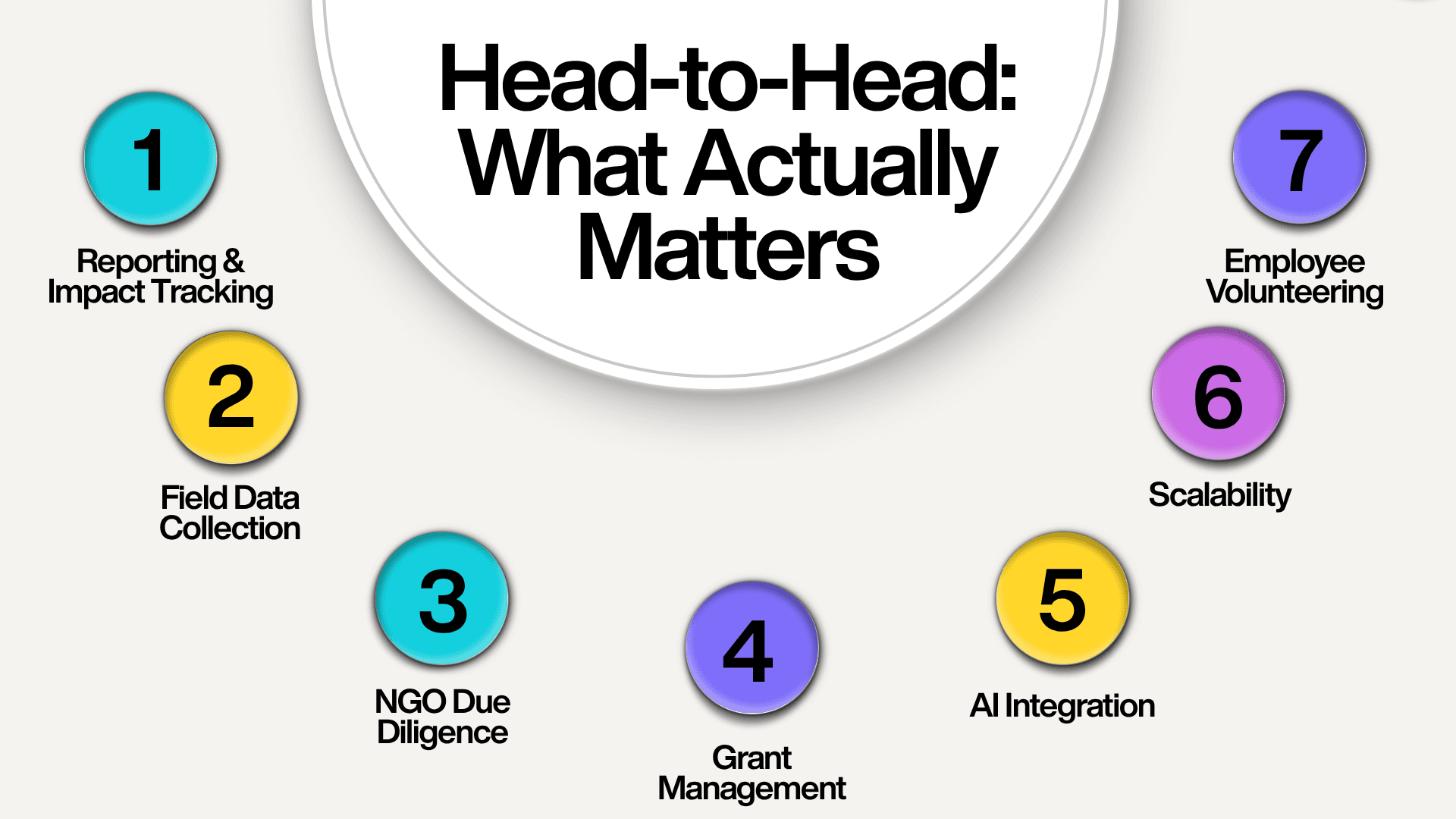
1. Impact measurement and reporting
Impact Dash leads on the output side dashboards, SDG/Schedule VII filters, and visual disclosures designed for boards and CSR committees. Relific leads on the input side, clean data flowing in means reporting becomes a query rather than a quarterly reconciliation project.
In 2026, the more demanding question is whether your reporting layer can survive an assurance review. If the answer requires backtracking through emailed Excel files and partner-submitted PDFs, the polish of the dashboard is irrelevant. Architectural integrity is the underrated criterion here.
Better for board-facing visualization: Impact Dash. Better for assurance-grade traceability: Relific.
2. Field data collection
Impact Dash supports field data ingestion but treats it as one input among many. Relific treats it as the structural foundation. If your programs depend on primary data collected at village, school, or clinic level, particularly in low-connectivity settings, Surve-R's adaptive forms and offline-first design are purpose-built for that.
Edge: Relific.
3. NGO due diligence and partner management
This is Impact Dash's clearest win. Native handling of 12A, 80G, and Form CSR-1 inside the partner onboarding workflow is a meaningful operational and compliance advantage in India. ProGran handles partner management competently and across the full lifecycle, but the documentary depth on India-specific compliance forms is where Impact Dash genuinely leads.
Edge: Impact Dash for documentary due diligence; Relific for end-to-end operational partner management.
4. Grant management
ProGran is closer to a fully formed grant management solution application intake, review, disbursement, milestone-linked tranches, outcome reporting. IdeaOne is purpose-built for the proposal side and is genuinely useful for NGOs seeking grants, but it's not built as a corporate grantmaker's full operations platform.
Edge for corporate grantmakers: Relific. Edge for NGOs writing proposals: Impact Dash.
5. AI integration
Both platforms invest in AI, but they bet on different applications. Impact Dash's ImpactGPT is an advisory layer useful for asking contextual questions about CSR, programs, and impact frameworks. Relific embeds AI into the operational workflow itself data validation, anomaly detection, program-design suggestions, and partner-document parsing.
Whether one is "better" depends on whether you want AI to help you think about CSR or to help you run it day-to-day.
Roughly tied: different applications, both legitimate.
6. Enterprise scalability
Impact Dash has the most proven reference base in India today, with 100+ organizations across multiple sectors. Relific is earlier in its scaling curve but has an architecture designed for forward-looking demands like BRSR Core assurance and integrated multi-program operations.
Edge for proven track record: Impact Dash. Edge for forward-looking architecture: Relific.
7. Employee volunteering
Voluntee-R, as a dedicated module, gives Relific a clear advantage if your CSR program is workforce-driven. Impact Dash supports volunteering as a metric but typically relies on HRMS integration or manual entry.
Edge: Relific.
A Decision Framework
Rather than picking a "winner," it's more useful to map platform fit to CSR strategy.
Choose Relific if:
-
Your CSR programmes run on primary field data: across agriculture, public health, education, climate, or livelihoods, and data quality is your binding constraint on credible impact measurement and donor reporting.
-
You are in or approaching the BRSR Core assurance cohort and need source-traceable, audit-grade ESG data flowing continuously from the field, not assembled retrospectively from PDFs and Excel files at year-end.
-
You manage 10 or more implementing NGOs and need the entire partner lifecycle onboarding, due diligence, grant disbursement, milestone tracking, M&E, and outcome reporting, inside a single, integrated workflow rather than stitched across tools.
-
Employee volunteering is a meaningful pillar of your CSR strategy and you need structured hours tracking, drive management, and ESG-aligned engagement reporting beyond what spreadsheets or generic HR tools can offer.
-
You are rebuilding or modernising your CSR tech stack and want a modular, AI-powered SaaS architecture, one that lets you adopt Drive-R, Surve-R, ProGran, and Voluntee-R independently or as a unified stack, rather than inheriting the constraints of a single legacy platform.
Choose Impact Dash if:
-
Your CSR program is anchored in compliance and disclosure Section 135 obligations, CSR-2 filings, and board reporting.
-
NGO due diligence documentation (12A, 80G, CSR-1) and audit-trail integrity sit at the top of your risk register.
-
You need GIS-based program coverage views for trustees, regulators, or independent assessors.
-
You value a long, multi-sector reference base over architectural novelty.
-
Your CSR is centrally managed, with implementing partners reporting in standardized templates.
Consider running both or a hybrid stack:
Some Indian companies are moving toward a best-of-breed CSR stack rather than a single platform. A pragmatic hybrid: Relific for field data collection, multi-NGO operations, and BRSR-aligned data plumbing; Impact Dash for board-facing dashboards, India-specific compliance documentation, and advisory tooling. The trade-off is integration overhead and the risk of recreating the very fragmentation both platforms are designed to fix. It can work, but only with clear data-ownership rules between the two systems.
How to Actually Evaluate (Beyond the Demo)
Most CSR software RFPs ask the wrong questions. They ask which features exist; they should ask how the platform performs under the conditions your team will actually face. Three evaluation criteria are more decision-relevant than a feature checklist:
1. Time-to-first-report. From the day the contract is signed, how many weeks until a useful, accurate report can be generated for your CSR committee? This question exposes onboarding friction, data migration cost, and how much manual configuration is needed before the platform produces value.
2. Multi-NGO onboarding cost. What does it take in time, training, and platform support to bring 10 implementing partners onto the system and have them contribute structured data? Many platforms demo well with one well-managed NGO and break under the operational reality of 15 mid-sized partners with limited tech capacity.
3. Audit-grade data integrity. Ask the vendor to walk you, end-to-end, from a single field-level data point to the disclosed number that would appear in your BRSR report. If they can't show an unbroken, time-stamped chain collection record, edit history, approval workflow, aggregation logic, the platform isn't assurance-ready, regardless of how its dashboards look.
On pricing. Neither Impact Dash nor Relific publishes public pricing, which is normal for B2B SaaS in this category. Build a 3-year TCO that includes: subscription, implementation, data migration, training (your team and NGO partners), ongoing support, and an honest estimate of the internal staff time spent working around platform gaps. A cheaper platform that requires constant manual reconciliation is almost always more expensive over three years.
The Final Take
If you read the marketing pages of every CSR platform in India, you'll come away thinking they all do the same thing. They don't.
Relific is built for organizations that treat CSR as an operational discipline, not a communications exercise, where impact is delivered in villages, schools, clinics, and fields rather than boardrooms; where the data problem is upstream and structural, rooted in inconsistent field collection, fragmented NGO reporting, and manual reconciliation, rather than a dashboard design issue; and where the organizational ambition is to produce verifiable, source-traceable evidence of social impact, audit-grade, BRSR-assurable, and SDG-linked, rather than polished narratives assembled once a year to satisfy a disclosure obligation.
Impact Dash is an excellent fit for organizations whose CSR function is, at its core, a compliance and disclosure function where the primary risk is regulatory, the primary audience is the board and the auditor, and the partner network is mature enough that documentary due diligence is the daily challenge.
The deeper shift, which both platforms are responding to in different ways, is that CSR is becoming an accounting discipline. Just as financial reporting evolved from bookkeeping to GAAP and IFRS, impact reporting is evolving from glossy annual reports to assurance-grade disclosure. The platforms that survive the next five years won't be the ones with the prettiest dashboards. They'll be the ones whose data can withstand external review.
Pick the platform that matches your current scale. But invest in the one that can match where the regulation is going.
Frequently Asked Questions
Q1. What's the core difference between Impact Dash and Relific?
Impact Dash is a compliance-led reporting and analytics platform with strong dashboards, India-specific regulatory features, and an advisory AI layer. Relific is an AI-native operations stack built to manage CSR end-to-end, from field data collection to grants to BRSR-aligned reporting. Impact Dash is your reporting layer; Relific is your operational engine.
Q2. Which is better for Companies Act Section 135 compliance?
Both serve the Indian context, but they emphasize different risks. Impact Dash has deeper native handling of NGO due diligence forms (12A, 80G, CSR-1), Schedule VII filters, and budget disbursal tracking inside one workflow. Relific covers this competently and pairs it with stronger field-data integrity, which matters more for BRSR Core assurance.
Q3. What does "BRSR Core assurance readiness" mean, and why should it drive the platform decision?
SEBI's BRSR Core requires reasonable assurance third-party verification on a defined set of ESG KPIs, with applicability extending to the top 1,000 listed entities by FY 2026–27. To pass an assurance review, every disclosed number has to be source-traceable: the assurer needs to follow it from the field record up. Polished dashboards alone don't satisfy this; auditable data plumbing does. Any CSR platform you evaluate in 2026 should demonstrate this trace, not just describe it.
Q4. Our CSR is mostly employee volunteering. Which platform fits better?
Relific has a dedicated Volunteer-R module covering hours, drives, engagement, and reporting. Impact Dash supports volunteering as a metric but typically relies on HRMS integrations or manual data entry. If volunteering is structurally part of your strategy, Relific gives you a more native workflow.
Q5. We work with 15+ implementing NGOs. Which platform handles multi-partner operations better?
Relific's ProGran is purpose-built for the partner lifecycle onboarding, disbursement, milestones, documentation, and outcomes inside one workflow. Impact Dash supports partner reporting and due diligence well, but is less optimized for operational lifecycle management at that scale.
Q6. How important is field data collection capability?
Underrated, often. The quality of your impact reporting is bound by the quality of the data feeding it. If your programs operate in rural, low-connectivity, or frontline-worker contexts health, agriculture, education, climate field collection should be a primary evaluation criterion, not a checkbox. Relific's Surve-R is designed for this; Impact Dash treats it as one input among several.
Q7. Neither platform publishes pricing. How should we evaluate cost?
Use a 3-year TCO that includes subscription, implementation, data migration, training (internal team and NGO partners), ongoing support, and the staff time spent on manual workarounds. The cheapest platform on the headline number is rarely the cheapest over three years.
Q8. Can these platforms integrate with our ERP and HRMS?
Both support integrations. Impact Dash works well as a reporting layer over existing data sources. Relific is API-first and integrates with modern ERP, HR, finance, and reporting systems. For complex existing tech stacks, validate integration during the pilot, not from the sales deck.
Q9. We're a small company starting our CSR program. Are these platforms overkill?
Both target mid- to large-sized organizations with established CSR programs. Relific's modular SaaS approach lets you start with one module and expand, which suits a growing function. Impact Dash bundles advisory services, which can help if you need help with both the technology and the underlying program design. Either way, get clarity on what you actually need before engaging vendors. Buying enterprise-grade platforms before your programs are mature is one of the more common procurement mistakes in this category.
Q10. The CSR software market is growing fast does that affect platform choice?
Yes, indirectly. The market is projected to grow from USD 973.7 million in 2024 to USD 1.72 billion by 2030. Both platforms are actively investing in product development, which means today's feature gaps may close in 12–18 months. When evaluating, weigh roadmap and shipping velocity, not just current feature parity.
Q11. What should we test for specifically in our RFP or demo?
Three questions matter more than feature checklists: (1) time-to-first-report how quickly can a useful report come out of the platform after onboarding? (2) multi-NGO onboarding cost what does it take to bring all your partners onto the system? (3) audit-grade data trail can the platform show an unbroken chain from a single field record to the final disclosed number? Build your demo script around these.
Q12. Can we use both platforms together?
Yes, and a small number of Indian companies are starting to. A workable hybrid: Relific for field data, grants, and program operations; Impact Dash for board-facing dashboards and India-specific compliance documentation. The cost is integration overhead and the risk of re-fragmenting data. Done well, it gives you best-of-breed in each layer; done poorly, it recreates the problem both platforms are trying to solve.